


The transportation revolution is here
Autonomous vehicles (AVs) are rapidly evolving from experimental concepts to real and operational transport ecosystems. In the US, Waymo already runs driverless robotaxi services in several cities, its vehicles have logged over 350 million fully autonomous kilometers and complete more than 400 000 rides every week. In China AVs have become part of everyday street life in major cities. Europe is progressing more cautiously, but the gap between experimentation and operational deployment is narrowing. Several countries have already adapted their legal frameworks to allow autonomous services on open roads, with international players such as Waymo planning to launch operations in Munich in 2027. The technology gap with the US and China remains real, but Europe is catching up faster than often assumed in terms of operational use cases. EU-funded initiative has committed up to €400 million between 2020 and 2026 to accelerate urban mobility innovation across the continent, including autonomous shuttle pilots.
.
For transport organisations, the question is no longer whether autonomous mobility will affect them, but how quickly they can seize the opportunities and manage the challenges ahead. Companies that proactively invest in this transition now will be significantly better positioned than those waiting for the technology to fully mature.
What is autonomous mobility?
Autonomous mobility refers to vehicles capable of operating with limited or no human intervention, combining hardware (cameras, LiDAR, radar), software (AI, HD mapping) and connectivity to perceive their environment, decide and navigate safely. The industry reference is the SAE J3016 standard, which defines six levels of automation, from 0 (no automation) to 5 (full automation, in all conditions).

The real technological and operational leap sits between Level 3 and Levels 4 to 5. Up to Level 3, the human remains part of the loop: the system detects its environment and can perform most driving tasks, but the driver must still be ready to override on request. At Level 4, the vehicle fully performs the driving task under specific, geofenced circumstances. Human override is optional but is no longer required for the system to operate safely. Level 5 goes a step further, performing all driving tasks under all conditions with theoretically zero human attention or interaction required, anywhere. Most commercially available systems today remain within the Level 2–3 range, where the human driver remains responsible for the driving task, thus legally responsible in case of accident. Autonomous mobility should not be reduced to a vehicle innovation: its real value emerges once it becomes part of a broader connected mobility ecosystem combining infrastructure, data, operators and users. This is why pilot shuttles are being tested in Belgium, in the city of Leuven targeting Level 4 directly, within a fixed, mapped route.
Belgium today: from pilots to first deployments
.
Belgium has moved beyond the planning stage, and the Leuven pilot is a genuinely national effort. Two autonomous shuttles supplied by WeRide, have been running in downtown Leuven since 11 September 2025, first in a testing phase as engineers mapped the city centre and learned local traffic patterns.
Since 22 January 2026, they have been carrying passengers on the newly created Line 16, a fixed 4 km afternoon route between Leuven Station and Heverlee, with capacity for 8 passengers and a safety driver behind the wheel. The project itself is unusually broad in scope; it brings together public and transport stakeholders from all three regions including the City of Leuven, Brussels Mobility, STIB-MIVB, and LETEC alongside De Lijn.
The explicit goal is to build shared knowledge so autonomous public transport can scale across all of Belgium’s regions.

.
Operating an autonomous shuttle in a real urban environment exposes the technology to the complexity that is difficult to reproduce in controlled test sites: pedestrians, cyclists, traffic lights, parked vehicles, roadworks, temporary obstacles and interactions with conventional traffic. It therefore provides an important learning environment for Belgium’s future autonomous mobility ecosystem.

The project also illustrates another characteristic of autonomous mobility: no single organisation can deliver it alone. Public transport operators, technology providers, municipalities, infrastructure owners, regulators and mobility platforms all have a role to play.
Other Belgian initiatives are also exploring autonomous mobility for applications such as airport transport and other controlled environments.
.
The regulatory landscape is evolving beyond public transport: Belgium is also adapting its framework for advanced driver-assistance and automated driving technologies in private vehicles, making Belgium the fifth EU country to do so after the Netherlands, Lithuania, Estonia and Denmark. Even though it remains a supervised Level 3 driver-assistance system, the pace of this regulatory shift illustrates that Belgian and European frameworks are adapting faster than the common narrative of a European lag suggests. The next challenge is to translate these individual pilots into a coherent framework for deployment.
Where can autonomous mobility create value?
.
- Improving operational flexibility
One of the strongest business cases for AVs lies in operational efficiency. By reducing dependence on traditional driver-based operations, autonomous services could improve operational efficiency, address driver shortages, and increase service flexibility. For public transport operators, autonomous shuttles can strengthen first and last-mile connectivity from railway stations, tram or metro stops to residential areas, business parks, hospitals, campuses and airports. This could be particularly relevant for lower-density areas where operating a conventional fixed bus route at high frequency is difficult.
- Enhanced safety
Human error is behind roughly 90% of road accidents worldwide, broadly split between speeding (~30%), driving under the influence (~25%), distraction (~25%) and fatigue (~10%).
These are precisely the risk factors autonomous systems, with 360° sensor coverage and constant vigilance, can significantly reduce.
No transport system is entirely risk-free and AVs won’t be an exception, but removing the human factors could substantially reduce traffic incidents over time, with significant societal benefits, including fewer insurance claims, and greater public confidence in transport systems.

- Building the Autonomous Mobility Ecosystem
Autonomous mobility is creating a new and broader connected mobility ecosystem shifting from vehicle-centric to service-centric transportation. New roles may emerge around autonomous fleet operations, remote assistance, Mobility-as-a-Service platforms, data management, digital customer experience and mobility orchestration. This could create new opportunities for collaboration involving public transport operators, technology companies, municipalities, infrastructure providers and mobility platforms. For transport organisations, the strategic question will be which capabilities to develop internally and which to access through technology and ecosystem partnerships.
Challenges to Scaling Autonomous Mobility
.
- Regulation and liability
Regulatory uncertainty remains the main obstacle to large-scale investment: legal liability in the event of accidents, insurance models, data governance, and cross-border operations remain a particularly sensitive issue in Europe. However, the EU is moving to close this gap. In June 2026, 18 Member States, including Belgium, signed a Joint Declaration of Intent to establish cross-border testbeds for autonomous vehicles, backed by an initial €20 million for dedicated digital infrastructure. It’s a real step towards regulatory alignment, but not yet an operational framework.
- Technological limitations
Despite major progress, AVs still struggle in complex, unpredictable urban environments. Most current systems only operate within a pre-defined area, relying on detailed HD mapping and continuous monitoring to handle situations they can’t yet manage alone. Connectivity remains essential for the link to remote supervision, which is a real issue in less-covered rural areas (“white zones”) and could slow deployment outside major urban centers. Given the safety-critical nature of transport, these systems will need to reach very high reliability before any wide-scale rollout.

- Sustainability and urban impact
Autonomous mobility could support more sustainable transport through shared fleets, optimised driving and reduced parking demand, but these benefits are not guaranteed. The same technology could just as easily reinforce individual, private car use rather than shared mobility, particularly if autonomy makes solo car trips more convenient and effortless. A proliferation of individual AV operators and fleets, each running their own vehicles and infrastructure, could work against the very consolidation that makes shared mobility efficient in the first place. Without the right policies and integration into wider mobility networks, AVs could increase traffic volumes and congestion rather than reduce them. Large-scale deployment would also create new infrastructure requirements, from charging and maintenance facilities to fleet depots and grid capacity. In a densely populated country such as Belgium, land availability and infrastructure integration should therefore be considered from the outset.
Beyond the Technology: A Strategic Approach
Autonomous mobility should not be treated as a technology project, but as a business transformation challenge. Mobility industry players that want to succeed should follow a strategic and phased approach: start by identifying the use cases that create value for the business, not just the ones that are easiest to demonstrate. Assess the operational and financial impact, including what needs to change internally to capture it. Build the internal capabilities and ecosystem partnerships before scaling, not after. And launch controlled pilots designed to generate real evidence, not just visibility. Scaling should follow proven outcomes, not enthusiasm.
How Avertim can support
Successfully navigating autonomous mobility requires more than technical expertise. It takes strategic vision, operational transformation capability and effective stakeholder management. Positioned at the intersection of business transformation, digital innovation and mobility, Avertim can help organisations translate autonomous mobility ambitions into measurable business value.
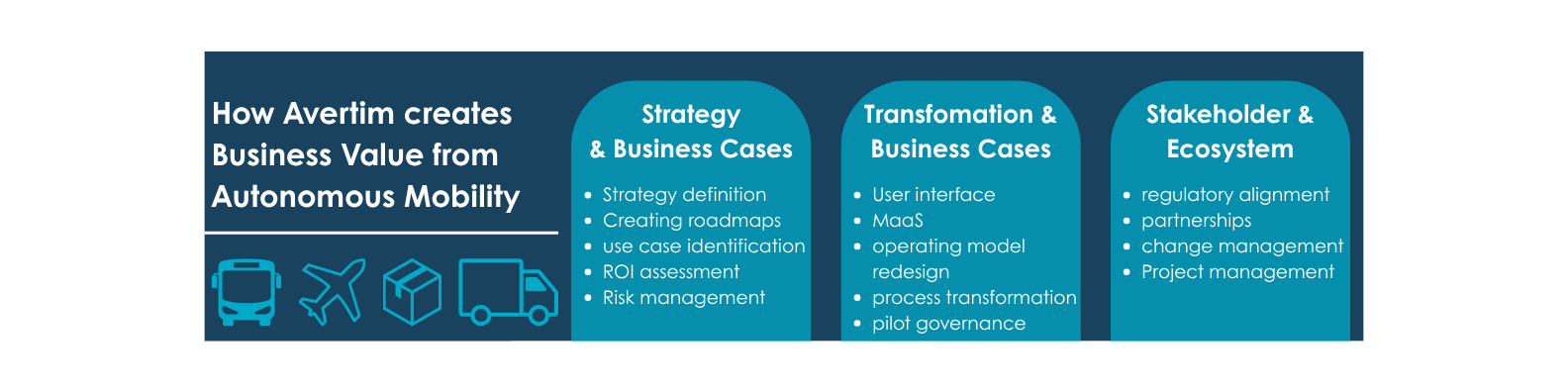
Whether supporting public transport operators, logistics providers, municipalities, airports, or companies exploring autonomous last-mile delivery, Avertim helps bridge the gap between technological innovation and operational reality.
Looking ahead
Autonomous mobility will not replace traditional transport overnight. But the technology has moved past pure experimentation and is steadily advancing toward commercial deployment. Organisations that wait for full maturity risk falling behind competitors already building expertise, partnerships and operational experience. Tomorrow’s leaders will not necessarily be the first to deploy autonomous vehicles, but those who best understand where autonomous mobility creates real business value. The time to start preparing is now.
Sources :
https://www.sae.org/standards/j3016_202609-taxonomy-definitions-terms-related-driving-automation-systems-road-motor-vehicles
https://aichair.upc.edu/en/members/eit-urban-mobility
EU Ministers back cross-border initiative for autonomous vehicle testbeds – Mobility and Transport
Servus München: Waymo is Coming to Germany
ROBOBUS – Leuven | Mobility Masterclass
https://www.delijn.be/fr/content/investeren-in-morgen/leuven-autonome-mobiliteit-in-actie/
https://www.3cems.com/the-6-levels-of-vehicle-autonomy_n69
